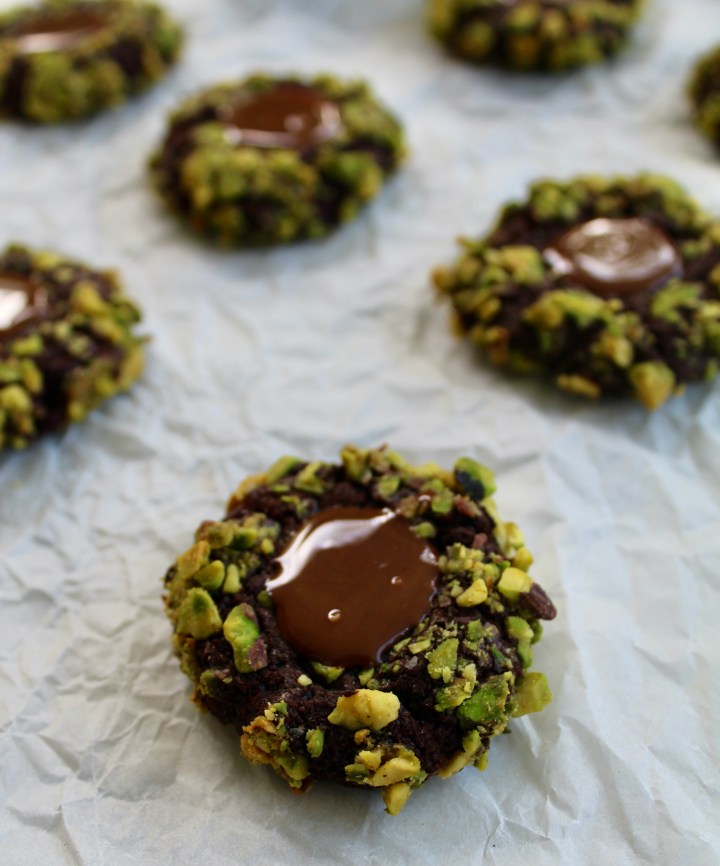
Chocolate Pistachio Thumbprints

Chocolate Pistachio Thumbprints

125g butter
160ml sugar
1 egg, separated
30ml milk
5ml vanilla
250ml flour
83ml cocoa powder, sifted
1,2ml salt
250ml pistachio, finely chopped
80g nut butter chocolate, chopped
15ml cocoa butter

Preheat your oven to 180℃ and line a baking sheet with baking paper.
Add the butter and sugar to the bowl of a stand mixer fitted with the paddle attachment and cream together.
Add the egg yolk, milk and vanilla and mix together.
Stir in the flour, cocoa powder and salt until combined.
Wrap the dough in plastic wrap and chill in the refrigerator for at least an hour.
Add the egg white to a small bowl and whisk until frothy.
Chop the pistachio finely (I do mine in a food processor) and place it in a shallow bowl.
Scoop up about 15ml of dough and roll it into small balls.
Now roll each ball in the egg white and then in the chopped pistachio.
Place the balls on the prepared baking sheet.
Use the back of a 2,5ml measuring spoon to make an indentation in the centre of each dough ball.
Bake the biscuits for 12 minutes.
Remove the baking sheet from the oven and immediately re-press the indentations you made. Set aside to cool completely.
Add the chocolate and cocoa butter to a heatproof bowl set over a saucepan of simmering water and allow to melt.
Stir every now and then until smooth and glossy.
Remove from the heat and stand the bowl for about 30 minutes.
Spoon the chocolate into the indent in each biscuit and set aside to allow the chocolate to set – preferably overnight.
Makes about 25 biscuits.

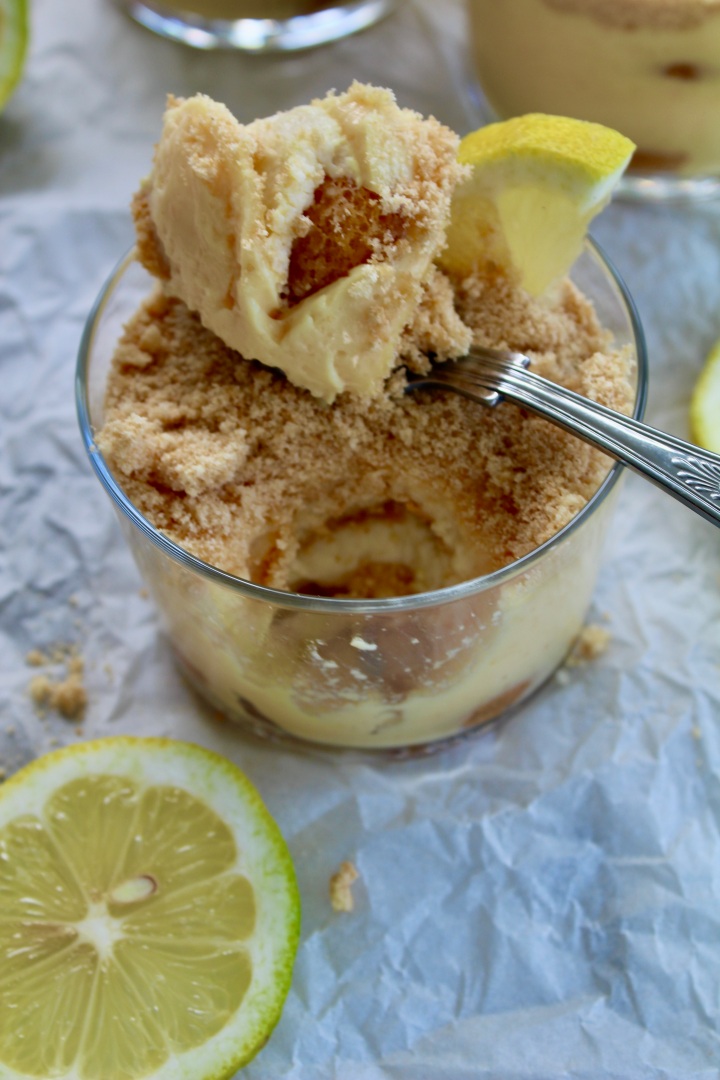
Layered Custard Pots

Layered Custard Pots

These custard pots are easy to make and can be kept in the refrigerator until ready to serve. Makes 12.

2 packets finger biscuits
1 can condensed milk
125ml lemon juice
90ml sugar
135ml custard powder
200ml + 800ml milk

Line up 12 ramekins or serving glasses.
Break/cut the finger biscuits in half and place 2 halves in each ramekin, “lining” the bottoms. Set aside.
Add the condensed milk and lemon juice to a mixing bowl and stir together until the mixture amalgamates. Set aside.
Add the sugar and custard powder to a mixing bowl and make a slurry by slowly pouring in the 200ml milk, while whisking.
Pour the 800ml milk into a saucepan and bring to the boil.
Pour in the the custard and sugar slurry and whisk vigorously. Whisk until the custard is thick and smooth and starts to bubble.
Remove from the heat.
Scoop about 60ml of the very hot custard on top of the finger biscuits in the ramekins.
Now scoop about 60ml of the condensed milk mixture on top of the custard layer and shake the ramekins slightly so that the mixture spreads and covers the custard layer.
Repeat the finger biscuit, custard and condensed milk layers.
Bash 12 finger biscuits until very fine and divide equally among the ramekins.
Place the custard pots in the refrigerator for a minimum of 4 hours.

Whoopy Peach Salad

Whoopy Peach Salad

This is without doubt one of the craziest ideas to READ about, but surprisingly satisfying and pleasing in a very old fashioned way. That statement in its own is somewhat out of the ordinary but please try this idea for a quick delicious side dish to smoked and salty meat dishes … you may just have a new favourite recipe!

1 large tin/can of peach halves
100g mature cheddar cheese, grated
60ml mayonnaise
60ml sour cream
125ml feta cheese, crumbed
a handful of basil leaves, chopped
a handful of pistachio or pine nuts
fresh lettuce to serve

Drain the peaches from the syrup.
Hold the peach in your hand with the rounded side facing upwards and make a shallow horizontal slice so that the peach can sit on it – cut away as little as possible.
Arrange some fresh lettuce on a serving plate and place the peach halves randomly, with the hollow facing upwards.
Fill each peach cavity loosely with grated cheddar cheese.
Add the yoghurt, sour cream, finely crumbed feta and chopped basil to a small bowl and stir together.
Spoon a generous dollop of the dressing onto the cheese in the peach cavity.
Scatter the pistachios/pine nuts over the salad and serve with the extra dressing on the side.

This salad goes surprisingly well with any smoked, cured or salty meat dishes that need that boost of natural sweetness.

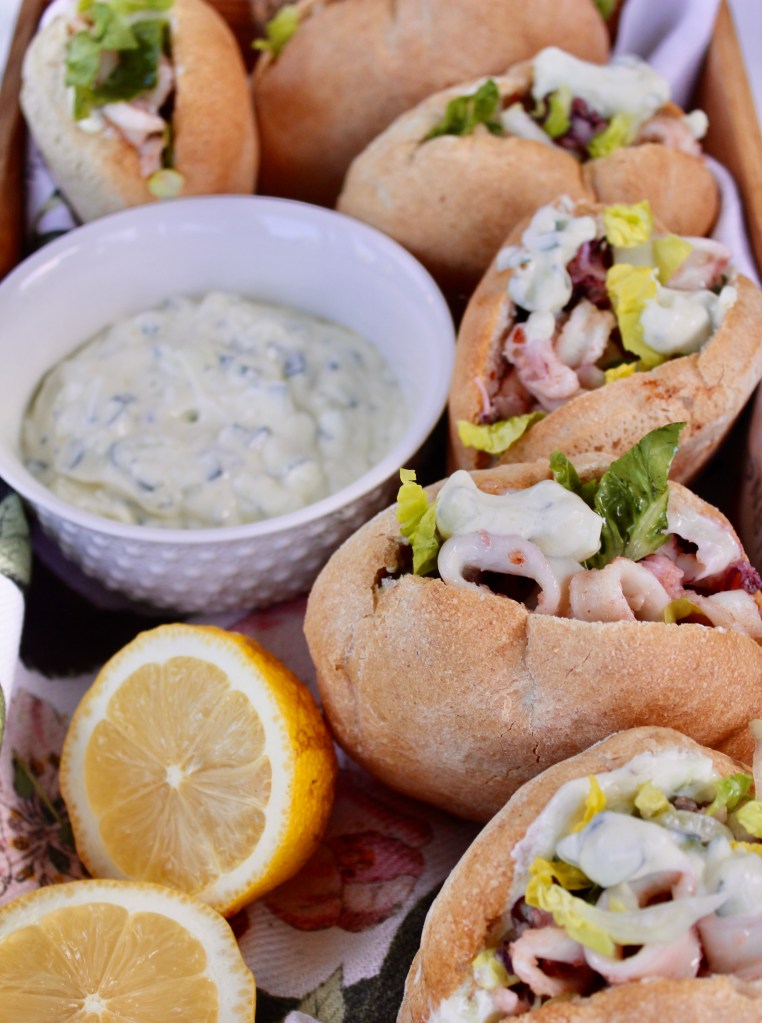
Greek Calamari Pita

Greek Calamari Pita

These calamari filled pita breads are the perfect casual weekend food for entertaining friends and family!! Serve them with a crisp, cold chardonnay and kick back Greek style!!

Lemon-Yoghurt Sauce:
125ml yoghurt
1 clove garlic, minced
5ml dijon mustard
45ml lemon juice
a handful of basil leaves, torn

1 kg calamari rings, washed and dried
45ml sunflower oil
1 lemon
salt and pepper

about 2 cos lettuce, shredded

Pita Bread – If you want to bake your own fresh pita bread you can go to the SEARCH goggle on this block to find the recipe

For the Sauce:
Add all the ingredients to a small bowl and mix well.
Cover with plastic wrap and set aside to infuse at room temperature.

Place a heavy-bottom pan over high heat and wait 2-3 minutes for the pan to get hot.
Turn the heat down slightly, more high than medium-high, add the oil to the pan and then the calamari rings.
Stir the calamari around for 2 minutes, NO MORE!, and immediately remove the pan from the heat.
Squeeze the lemon onto the calamari while it is still sizzling and season generously with salt and pepper.

Hold the pita bread upright (on the seam) and make an incision about a third of its circumference.
Lightly push two fingers in and wiggle them around to separate and open the inside of the bread, so that you have a large pocket.
Scoop a spoonful of the lemon sauce into the cavity and smear it around with the back of the spoon.
Place a thin layer of the shredded lettuce on the bottom of the pocket, then a layer of calamari and then a layer of the sauce.
Push all of this down with the back of the spoon so that you will have enough space for a repeat of layers.

Serve the calamari pitas with the leftover sauce on the side.


Lemon Dressing

Lemon Dressing

This is one of the best salad dressing you will ever make AND you can keep it in your refrigerator!! Delicious when drizzled onto seafood!

62ml lemon juice
1 clove garlic, minced
5ml Dijon mustard
1,2ml salt
a pinch of ground black pepper
7,5ml honey
62ml olive oil
5ml thyme leaves, chopped

Add the lemon juice, garlic, mustard, salt, a pinch of black pepper and honey to a small bowl and whisk together.
Drizzle in the oil while whisking. Keep going until all the oil is incorporated and the mixture has emulsified.
Add the thyme leaves and stir through.

Store left-over dressing in a glass jar, in the refrigerator.

Chocolate-Biscuit Meringue

Chocolate-Biscuit Meringue

The recipe makes about 18 meringue biscuits.

4 egg whites, room temperature
220g caster sugar
5ml white vinegar
250ml ladies finger biscuits, chopped (or any other plain biscuit)
250ml almond slivers
160g chocolate of your choice; I used De Villiers Nut Butter with no added sugar

Preheat your oven to 150℃ and line 2 baking trays with baking paper.
Add the egg whites to the bowl of a stand mixer fitted with the whisk attachment and whisk on high speed until medium peaks form.
Add one tablespoon of sugar at a time, with the mixer running. Wait 30 seconds before adding the next tablespoon of sugar and continue until all the sugar has been added.
Whisk on high speed for 2 more minutes.
Add the vinegar and whisk 2 minutes more.
Take the bowl from the mixer and add the biscuits and almonds. Fold through.
Add the chocolate to a heatproof bowl set over a saucepan of simmering water and allow to melt completely.
Spoon a tablespoon of the meringue mixture onto the prepared tray and flatten slightly with the back of a spoon.
Spoon a teaspoon of the melted chocolate on the meringue and swirl it into the top.
Now reduce your oven temperature to 120℃ and place the trays in the oven. Bake for 30 minutes.
Turn off the oven, without opening the door and leave the meringue inside for another 30 minutes.
Remove the trays from the oven and leave the meringue on it until completely cold – another hour or so.

Store the meringue biscuits in an airtight container.


Quick-Bake Passionfruit Tart

Quick-Bake Passionfruit Tart

This tart is makes for the perfect summer dessert when served with a scoop of ice cream and extra passionfruit pulp drizzled on top. It is so easy to make, you only need to take out a mixing bowl and a whisk!!

4 eggs
250ml milk
5ml vanilla
125g butter, melted
250ml caster sugar
125ml passionfruit pulp and extra for drizzling once you serve
125ml flour
250ml desiccated coconut

Preheat your oven to 170℃ and spray a 24cm tart tin with cooking spray.
Add the eggs, milk, vanilla, butter, sugar, passionfruit pulp, flour and coconut to a mixing bowl and whisk together.
Pour the batter into the prepared tin and bake for 50 minutes.
Cool the tart for 10 minutes before refrigerating for at least 2 hours.
Dust with icing sugar and drizzle with passionfruit pulp.

Buttermilk Roasted Chicken

Buttermilk Roasted Chicken

This is one of the easiest ways of roasting a chicken and will leave you with juicy, fall-off-the-bone meat and a delicious gravy.

1 whole chicken
10ml salt
30ml vegetable oil
30ml butter
60ml sage leaves, roughly chopped
the juice of two lemons
one garlic bulb, halved horizontally
500ml buttermilk
100ml milk

Preheat your oven to 190℃.
Wash and dry the chicken and rub the salt over the entire bird.
Add the oil and butter to a saucepan over high heat and brown the chicken, turning it as you go along.
Turn off the heat and add the remaining ingredients to the saucepan.
Put a lid on/cover with aluminium foil and cook in the oven for 40 minutes.
Remove the lid and cook uncovered for a further 50 minutes.
Place the chicken on a serving dish.
Strain the sauce through a fine mesh/sieve and serve it on the side with the chicken.

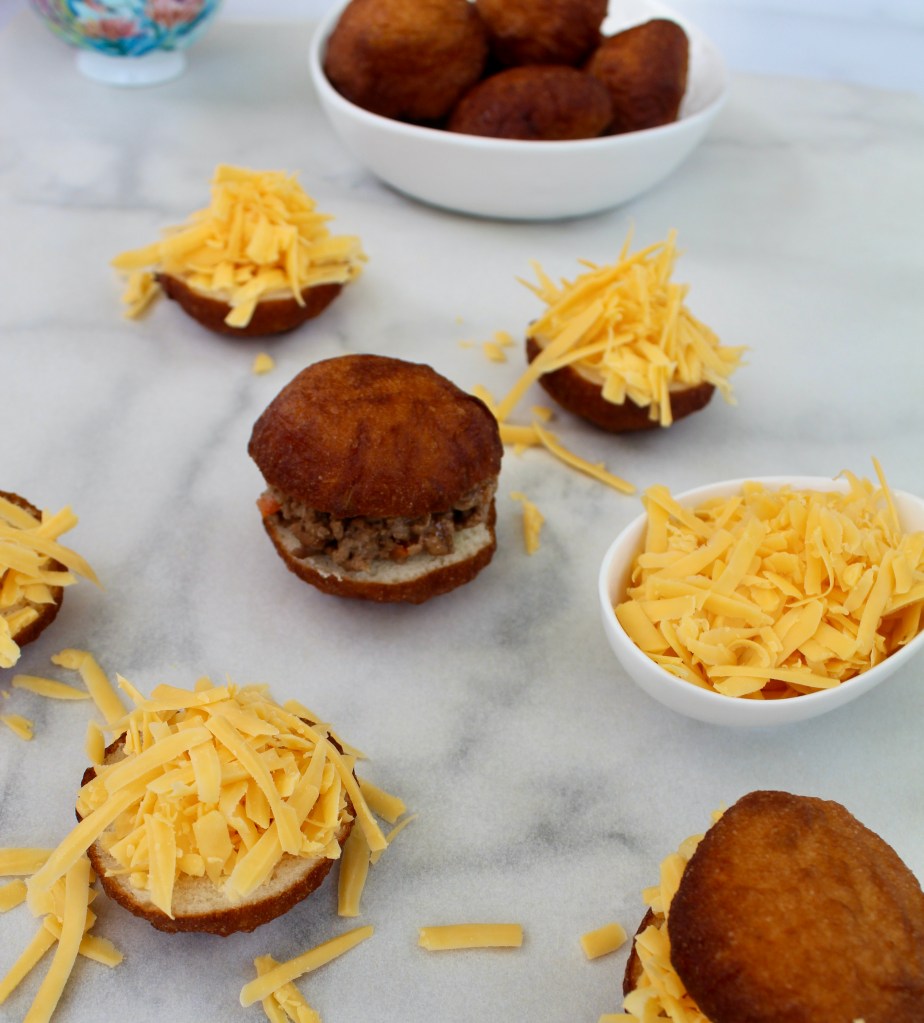
Vetkoek – Magwinya

Vetkoek – Magwinya

This is a traditional South African food that is popular as a quick meal and often eaten as is, filled with minced meat or with cheese and syrup. Vetkoek literally means “fat cakes” as it is basically a deep-fried bread. Magwinya is simply shaped differently, smaller than tennis balls and often found in Townships or sold as a on-the-go breakfast at taxi ranks.

10g dried yeast
900g cake flour
10ml salt
10ml sugar
vegetable oil for frying

Pour 250ml of warm water (tepid) into a mixing bowl and sprinkle the yeast on top. Stir to dissolve the yeast and set aside.
Add the flour, salt and sugar to the bowl of a stand mixer fitted with the dough hook.
Run the mixer on low speed and add the yeast mixture.
Now add some more lukewarm water (about 400ml) until the mixture comes together in a soft dough.
Knead on medium speed for 6 minutes.
Transfer the dough to an oiled mixing bowl, cover with a tea towel and set aside for 90 minutes.
Knock back the dough by kneading it by hand for 1 minute.
Pour about 2 litres of vegetable oil into a saucepan over medium-high heat.
If you are making Magwinya, pinch off some dough and shape it into a ball, about the size of a golf ball.
If you are making vetkoek, pinch off twice the amount of dough, roll into a ball and then press it flat between your hands.
Place the shaped dough on an oiled tray until you have shaped all the dough and the oil is warm.
Test the oil with a small piece of dough: if the dough starts bubbling and rises when dropped into the oil, it is hot enough.
Deep-fry the magwinya/vetkoek in the oil, turning them often for about 3 minutes or until they are a deep golden brown.
Scoop out and drain on kitchen paper.
Serve warm with mince/ragou or grated cheddar cheese and golden syrup.