Fig and Honey Tart

Fig and Honey Tart

Pastry:
250g butter, cubed
170g icing sugar, sifted
500g cake flour
2 eggs, beaten together

Crème Pâtissière:
40g corn flour
500ml milk
4 egg yolks
100g sugar
5ml vanilla

100g pistacchio nuts, roughly chopped
about 16 medium figs
50ml honey

For the pastry:
Add the butter and sifted icing sugar to the bowl of a food processor.
Run the machine until the mixture is well combined and pasty.
Add the flour and pulse until the mixture resembles wet sand. Scrape down.
Drizzle a few drops of the egg into the bowl with the engine running. Add a few more drops at a time until the mixture comes together. (You may have egg left and that is okay – the less you need the crispier the pastry!)
Shape the pastry into a disc, wrap it with cling wrap and refrigerate for 30 minutes.
Preheat your oven to 190℃.
You will use a 22cm loose-bottom flan tin but do not spray or butter the tin!
Roll the pastry to a 3mm thickness and line the bottom and sides of the tin.
Dock the pastry with a fork and bake blind for 15 minutes.
Remove the baking paper and weights/beans and set aside to cool.

For the Crème Pâtissière:
Add the corn flour to a mixing bowl. Pour a small amount of the milk into the owl and stir to make a slurry with the corn flour.
Add the egg yolks and half the sugar.
Whisk by hand until the sugar has dissolved. Set aside.
Pour the rest of the milk and the rest of the sugar into a small saucepan.
Set over medium heat and stir until the sugar has dissolved.
Take the milk from the heat as soon as tiny bubbles start to appear around the edge of the saucepan.
Drizzle the warm mixture onto the egg mixture in a very thin stream while whisking continuously.
Now pour the mixture back into the saucepan and place on a medium-low heat.
Stir until the mixture is thick and smooth. Allow to cook for about 30 seconds.
Remove from the heat and stir in the vanilla.
Pour the mixture into a shallow bowl, place a piece of plastic wrap directly onto the surface and allow to cool completely.

Whisk the mixture by hand once it is at room temperature, until it is smooth.
Spoon it into a piping bag and pipe into the prepared pastry shell.
Scatter the chopped pistachio evenly over the surface.
Cut a cross into the top third of each fig and place the figs side-by-side on the pistachio.
Drizzle the honey over the figs before serving.

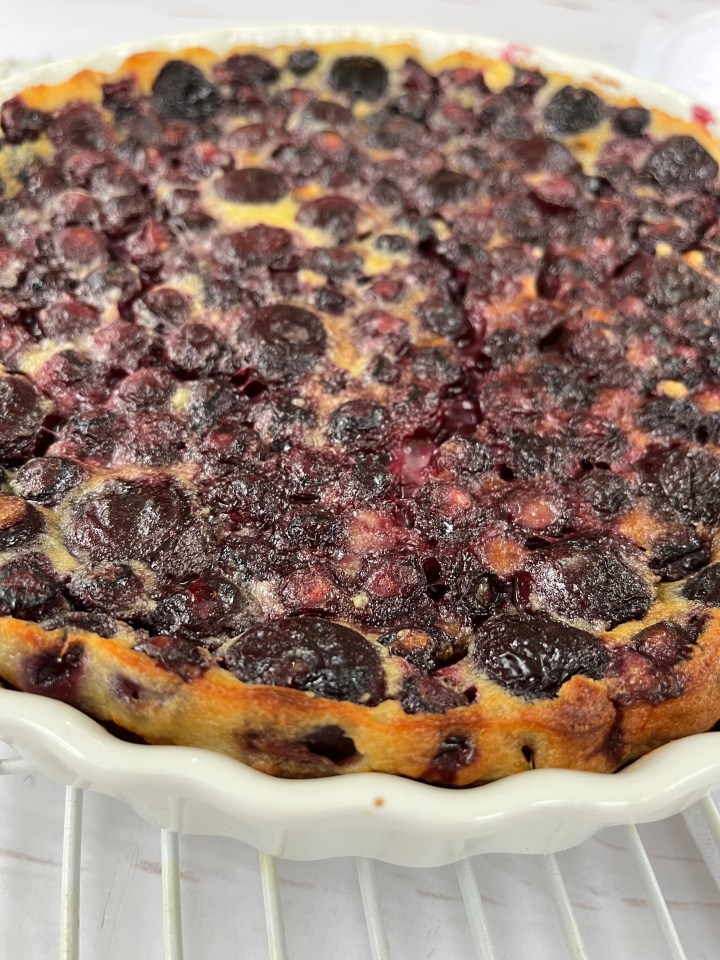
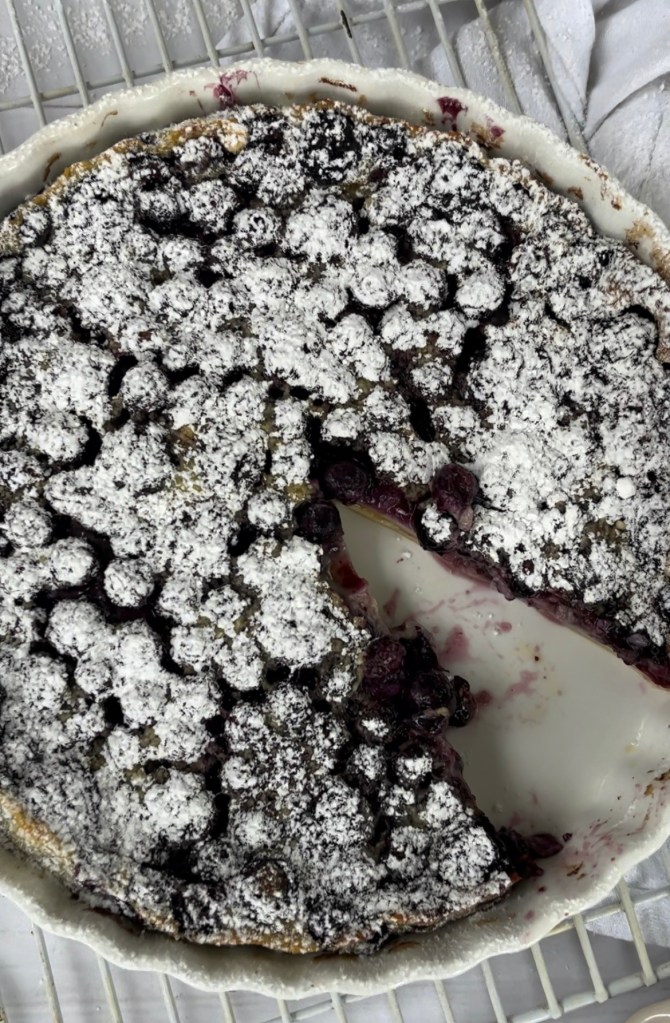
Traditional Clafoutis

Traditional Clafoutis

125ml sugar
125ml flour
3 eggs
5ml vanilla
30ml butter, melted
250ml milk
enough pitted cherries to cover the bottom of a pie/flan dish

Preheat your oven to 180℃ and grease a ceramic pie/flan dish.
Add the sugar and flour to a mixing bowl.
Whisk the eggs, vanilla, melted butter and milk together in a wide-mouth jug.
Slowly pour the milk mixture into the dry ingredients while whisking.
Fill the bottom of the pie dish with an even layer of cherries and pour the batter over the cherries.
Bake in the oven for 40 minutes.
The clafoutis will puff up in the oven and fall back on itself as it cools.
Dust with icing sugar once cooled.

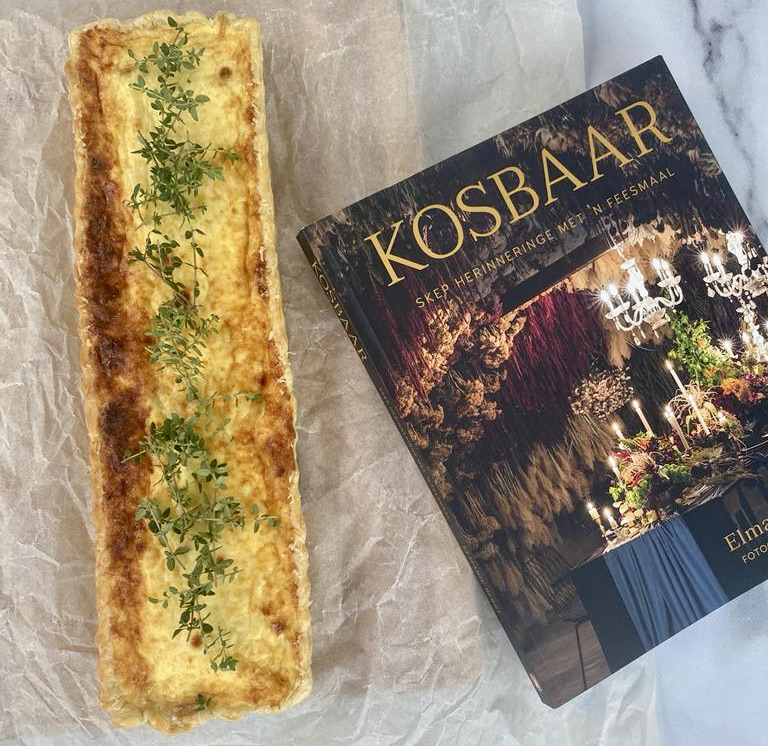
French Onion Tart

French Onion Tart

The South African cook and food blogger, Elmarie Berry has recently launched her recipe book Kosbaar. This is my interpretation of her delicious French Onion Tart.

1 batch Caramelised Onions, search the recipe on this blog
250g puff pastry, store bought
250ml sour cream
2 eggs
30ml thyme leaves
parmesan cheese, to grate on top

Preheat your oven to 200℃ and spray a 20cm loose bottom tart tin with cooking spray.
Line the tart tin with the puff pastry.
Spoon the cooled Caramelised Onions into the unbaked tart shell and spread it out evenly.
Whisk the sour cream, eggs and thyme together and pour over the onions.
Grate a good amount of Parmesan cheese on top and bake in the oven for 20 minutes.
Cool the tart on a cooling rack before taking it out of the tart tin.
Serve at room temperature.

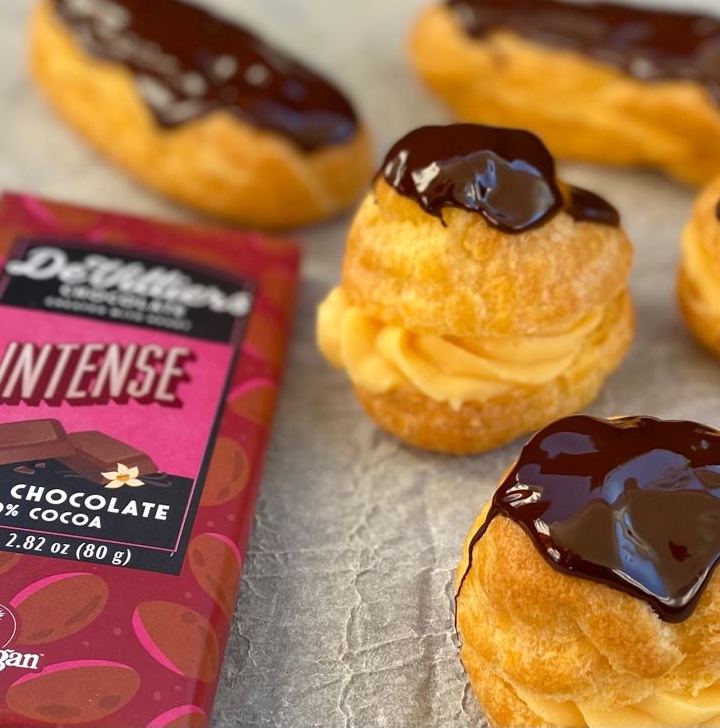
Profiteroles

Profiteroles

There is absolutely no “hidden tricks” when it comes to baking perfect profiteroles! Follow the instructions and you will have the satisfaction of perfect fresh profiteroles on your teatime table.

250ml boiling water
125ml butter, cubed
250ml cake flour
2,5ml salt
4 eggs
80g dark chocolate, melted
1 batch crème pâtisserie (search this blog for the recipe)

Preheat your oven to 190℃ and line a large baking sheet with baking paper.
Pour the water into a cast-iron/heavy-bottom saucepan and bring to a rapid boil.
Add the cubed butter and stir until melted.
Add the salt to the cake flour and then add it all to the saucepan with boiling water-butter, at once.
Stir vigorously with a wooden spoon until the mixture comes together in a ball in the centre of the saucepan.
Take the saucepan from the heat and add the eggs, one at a time.
Beat the mixture well. The egg should be completely incorporated before you add the next one. This is a real arm workout but do try and work quick as you need the steam from the heat!
Spoon a heaped teaspoon of the mixture on to the prepared baking tray, leaving enough space in between as the profiteroles expand quite a lot while baking.
Place in the oven and bake for 20 minutes.
Turn the oven temperature down to 160℃ and bake for another 20 minutes.
Take the tray from the oven and immediately slit a small sharp knife into the bottom of each profiterole, making as small a cut as possible, for the steam to escape.
Cool completely on a cooling rack.
Cut the profiteroles open and fill each of them with crème pâtissière (search the recipe on this blog: Custard Buns) or whipped cream.
Spoon some melted chocolate on to each filled pastry and set aside for the chocolate to set.
Serve with a smile!

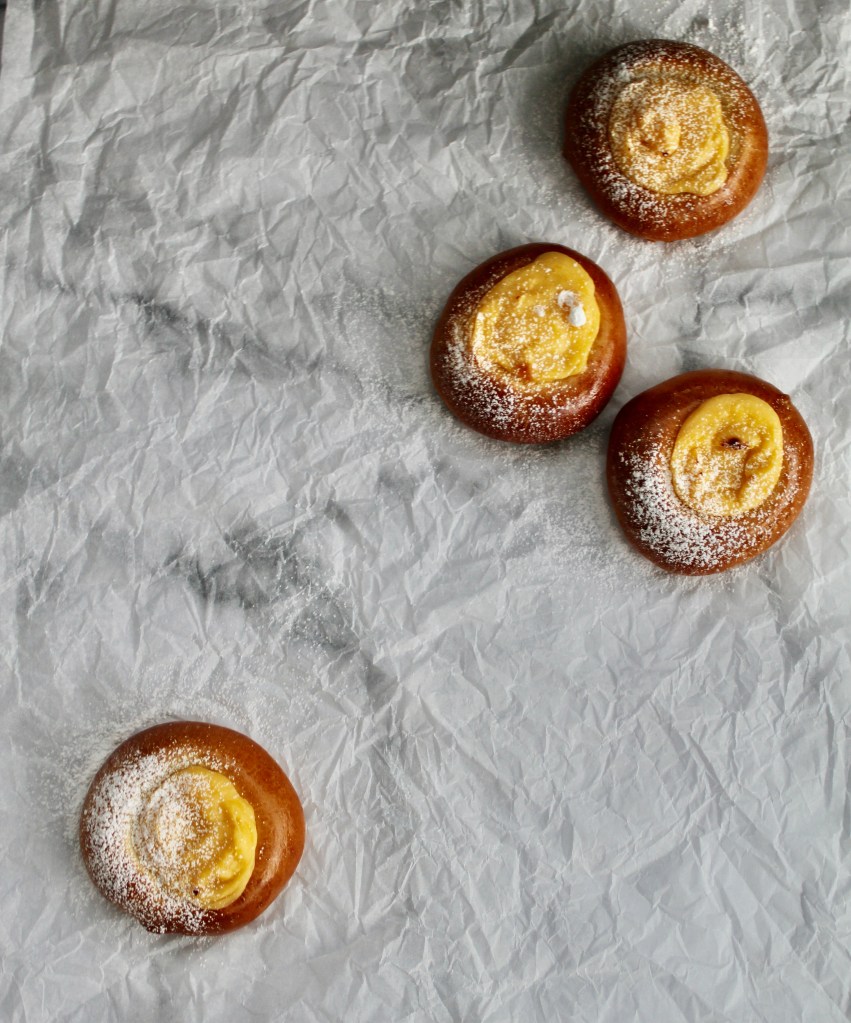
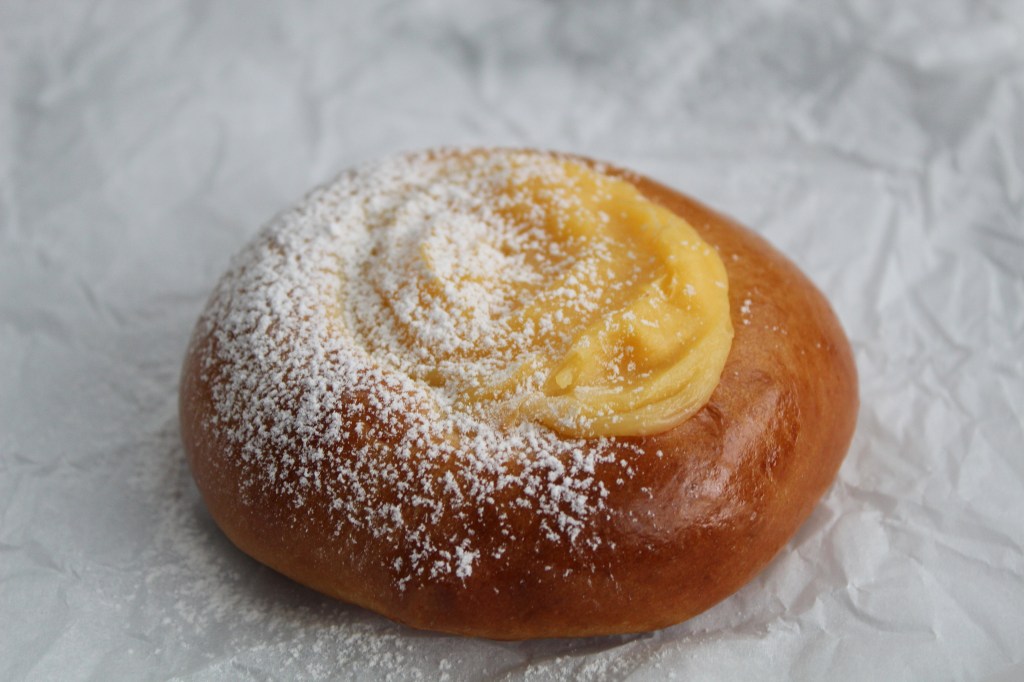
Custard Buns

Custard Buns

Who can say no to an espresso and pain à la crème on a sidewalk in Paris? I assure you, you might be in your own home but your tastebuds will be fooled into believing you were there….

Buns:
325g bread flour
3,7ml salt
150ml milk
40g butter
10g instant yeast
35ml sugar
1 egg

Crème pâtissière:
40g corn flour
500ml milk
4 egg yolks
50g + 50g caster sugar
5ml vanilla

Egg wash: 1 egg and 15ml water whisked together

For the buns:
Line a large baking sheet with baking paper and put aside.
Add the flour and salt to the bowl of a stand mixer fitted with the dough hook.
Warm the milk until tepid and pour it into a mixing bowl.
Add the butter, instant yeast and sugar to the milk and stir until the sugar has dissolved.
Turn the mixer on to a low speed and add the liquids. Mix/knead for about 3 minutes. The dough will be very sticky!
Turn the mixer to medium speed and knead for another 6 minutes. You are aiming for a soft, smooth, elastic dough.
Divide the dough into 10 equal pieces – weigh them on a scale, they should be around 60g each.
Roll each portion into a ball and place on the prepared baking sheet.
Flatten the dough ball slightly with your hand.
Now make an indent with a small cup/glass, pushing down onto the dough.
Spray some plastic wrap with cooking spray and cover the buns lightly.
Set aside in a warm place for 90 minutes.

For the crème pâtissière:
Add the corn flour to a small bowl and pour a small amount of milk in to the bowl while stirring. You want to make a slurry, which is basically a runny, pourable paste. Put aside.
Add the egg yolks and 50g caster sugar to a mixing bowl.
Stir the corn flour slurry into the egg mixture. Set aside.
Pour the milk into a small saucepan and add the other 50g caster sugar.
Place the saucepan on medium heat and stir until the sugar has dissolved.
Take the saucepan from the heat as soon as tiny bubbles start to appear around the edges of the pan.
Drizzle the warm milk mixture into the egg mixture while whisking vigorously. Pour slowly, whisk quickly!
Now pour the mixture from the mixing bowl, back into the saucepan and place it on a medium-low heat.
Stir continuously until the mixture has thickened.
Allow to cook for 30 seconds before removing it from the heat.
Add the vanilla and stir to mix.
Pour the crème pâtissière into a shallow bowl and place some plastic wrap directly on the surface. This will prevent a skin from forming while the custard cools down. Place in the refrigerator and allow to cool completely.

Preheat your oven to 180℃.
Take the same cup/glass that you used to make the indents in the buns, and press down onto the exact same area again.
Brush the buns with egg wash.
Whisk the cold créme pâtissière to soften it.
Spoon about 20ml or more if you can, of crème pâtissière into each round indent you have made.
Bake the custard buns for 20 minutes. The custard filling will rise up as it bakes but do not panic, it will fall back on itself once it cools.
Cool the buns to room temperature.
Sieve with icing sugar and serve with coffee.

Crêpes Suzette

Crêpes Suzette

This is one of my favourite French desserts and really easy to make. Make the crêpes the day before you need them and simply reheat them in the orange-caramel-syrup before serving.

Crêpes:
750ml cake flour
2,5ml baking powder
5ml salt
500ml milk
250ml water
125ml sunflower oil
4 eggs

Orange sauce:
45ml caster sugar
250ml orange juice
the zest of one orange
5ml lemon juice
15ml brandy
50g butter, cubed

For the crêpes:
Add the flour, baking powder and salt to the bowl of a stand mixer fitter with the whisk attachment.
Whisk the milk, water, oil and eggs together in a separate wide-mouthed jug.
Turn the mixer on to a low speed and add the liquid ingredients in a very thin stream. Keep whisking and pouring until all the liquid has been added.
Turn the mixer on to a higher speed and whisk for at least two minutes.
Remove the bowl from the mixer, cover with plastic wrap and allow to stand for 1 hour.
Heat a crêpe pan/frying pan until hot. Add a small amount of vegetable oil and swirl it around the pan. Pour the oil out and put the pan back onto a medium-high heat.
Spoon a ladle-full of the batter into the pan and cook until small holes appear over the entire surface of the crêpe.
Flip the crêpe and cook for 1 minute on the other side.
Slide the cooked crêpe onto a plate and continue baking the rest.

For the orange sauce:
Tip the caster sugar into a non-stick frying pan on medium to low heat.
Allow the sugar to melt without stirring it. You want the sugar to turn a caramel colour without burning it – watch it like a hawk and do not walk away from it!
Take the pan from the heat when the sugar is brown enough and add the orange juice, orange zest, lemon juice and brandy.
Return the pan to a very low heat. Do not panic if the sugar has seized, continue heating over a low heat and stir lightly until the sugar has dissolved completely.
Now start adding the butter, one or two cubes at a time while stirring constantly. Keep going until you have incorporated all the butter.
Bring the mixture to the boil, turn down the heat and simmer until the sauce has thickened slightly and has a lovely gloss to it.

Fold each crêpe into half, and then fold it again so that you have a more-or-less triangular shape.
Gently slide the folded crêpe into the pan and spoon the sauce over it.
Serve immediately.

Tripe

Tripe

Tripe is eaten all over the world but in South Africa it is often served as a curry. Also known as Mogodu or Afval, one is often surprised at the popularity of this traditional dish.

1kg tripe, cleaned
coarse salt
5 litres water
15ml curry powder
10ml ginger powder
15ml turmeric powder
10ml sugar
5ml salt
1 bay leaf
4 medium potatoes, peeled and cut into chunks

Put the clean tripe into a large bowl and sprinkle liberally with coarse salt.
Add about half the water and leave to soak for an hour.
Rinse the tripe under running water.
Cut into bite-sized pieces and place in a large saucepan.
Add the remaining water and a tablespoon salt.
Bring the tripe to a boil and simmer for about 3 hours, until tender.
Remove the tripe from the water and set aside.
Pour enough oil into a medium saucepan to cover the bottom.
Add the curry powder, ginger, turmeric, sugar, salt and bay leaf and cook on a low heat for a minute or two.
Add the tripe pieces and stir-fry until the tripe is covered in the spices.
Add the potato chunks and pour enough water into the saucepan to cover the tripe and potato.
Cook on a low simmer for about 40 minutes.
Serve the tripe on rice or a starch of your choice.